
3 Reasons Belarus is helping Putin destroy Ukraine
3-reasons-belarus-is-helping-russia-wagehttps://theconversation.com/3-reasons-belarus-is-helping-russia-wage-war-against-ukraine-177984
March 4, 2022 No Comments
Dr. Lockwood’s take on The Situation in Ukraine
Dear Faculty, Staff, Residents and Students:
I am sure you are all saddened by the events unfolding in Ukraine. It is unimaginable that in 2022 we are seeing such wanton cruelty and atavistic behavior. History, it would appear, repeats itself yet again, allowing us to glance again at the barbarous side of humanity. The chronological record of sapiens is littered with the tragic machinations of tyrants, autocrats and bullies seeking to exploit the perceived vulnerability of neighbors for political, financial, and geographical gain. Thus, our hearts go out to the Ukrainian people who must now resist an unprovoked invasion by Russian forces led by a sinister autocrat surrounded by thuggish cronies.
The Spanish poet and philosopher Santayana said, “those who do not learn from history are doomed to repeat it.” And because we failed to heed the lessons of the 1930’s we now are reliving through the anguish of Ukrainians what was felt by the Czechs, Poles and all those parts of Europe invaded by Hitler and his murderous Nazi thugs, and by the Chinese, Koreans and other South Asians subject to the horrors of invading militarism during World War II.
We were also woefully unprepared for those struggles. Americans then as now were attempting to regain their footing in the wake of an economic calamity; Americans then as now were wrestling with ideas of both democracy and authoritarianism; free market capitalism and socialism; appeasement and re-armament; isolationism and engagement. Then as now, foreign dictators sought to exploit what they misperceived as intrinsic weakness of democracies, but what was in fact the rigorous debate of an open society and a free people. Pre-WWII, the miscalculations of these dictators are what unified America and its allies and awoke in us a dormant martial vigor which rose to crush them.
Our current internal challenges in America, which just a few weeks ago seemed so important, pale by comparison to those being endured by the brave people of the Ukraine who are facing sophisticated weaponry, cyber-attacks and the unparalleled treachery of a superpower, albeit a failed and fading one. The actions of Putin and his willing accomplices make it clear that as a free people, we can never again afford to be so introspective, self-centered, and greedy as to miss the opportunity to resist forces which are antithetical to free civilizations.
We have underestimated and appeased the sitting governments in Moscow and Beijing, imagining that they shared our values. They most assuredly don’t! Ukraine should serve as a powerful stimulus to renew the same spirit which allowed us to resist and defeat the failed ideas espoused by the Axis Powers and then to endure and ultimately triumph in the long twilight struggle of the Cold War. A free people must always be vigilant. And while we rediscover our own martial spirit, let us do all we can to support the Ukrainian people.
Sincerely,
Charly
Charles J. Lockwood, MD, MHCM
Senior Vice President, USF Health
Dean, Morsani College of Medicine
March 1, 2022 No Comments
Happy 94th
If my dad was born just one day later (2-29-1928) he’d be 23 1/2 this year. Were that only so. Happy 94th Birthday Dad, we miss you.
One of Many
Passion Rules!
February 28, 2022 No Comments
Remember when
Remember the ‘perfect’ phone conversation less than two years ago Donald Trump had with Volodymyr Zelensky withholding $400M in defense support from Ukraine unless he lied about Biden? An even sadder memory today given what has transpired.
One thing is perfectly clear, Vladimir Putin is a war criminal. Say it, say it over and over again. That description should follow his name for eternity; Vladimir Putin, War Criminal.
And what do you call those who support a war criminal? War criminals the same.
God save the brave people of Ukraine.
Passion Rules!
February 27, 2022 No Comments
Fuchs stepping down as President at University of Florida
President Fuchs is stepping down at the University of Florida.
It’s a shame he is leaving on such a sour note given the recent missteps. He accomplished much while at UF but politics always gets in the way. I wish him well.
As our TV spot says: Go Gators; Go start a Fortune 500 Company, Go Write the Great American Novel, Go Cure Cancer, Go to Mars.
Good luck President Fuchs!
https://news.ufl.edu/2022/01/president-kent-fuchs-announces-plans-to-transition/?fbclid=IwAR0yiI0m0_RDRrVLQ0SJ9dnLNbcCZuuoDPlxuPhV0VeHZBnETkzDDbcsKVk
January 5, 2022 No Comments
Tesla offers holiday greetings
A Christmas gift from Tesla. You’ve really got to see it in person to appreciate all the sights and sounds (which are coming from the car’s stereo). Happy Holidays😎🎅🏼🎄
December 30, 2021 No Comments
The Tesla Saves the Day
Not long ago the family and I, along with the three Papillons, were driving to Atlanta for a family gathering. We left Tampa early and by 6:30 a.m. were nearing Ocala . . . and the morning rush hour traffic on I-75. So much fun.
The cruise control kept us on pace with the surrounding traffic and things were going fine. Fine, that is, until a large metal box fell off a truck in front of us and came flying toward the car. Literally flying. I mean it seemed to be heading right toward the windshield at 75 mph before it hit the front of the car and proceeded to roll under the left front wheel and left back.
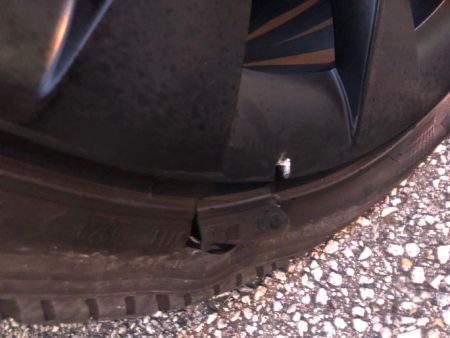
Catastrophic Tire Failure was the alert that lit the dashboard as the car jumped, waking my wife, daughter, Hominy, Redford and Grits. Fortunately for us, the car, a Tesla Model Y, had detected the collision milliseconds before it happened and when the sidewall of the front tire blew we didn’t even move out of our driving lane. The car began a controlled slow-down and instead of swerving into traffic to our left or right, I was able to gradually move off the interstate and out of the traffic flow. I saw cars around us swerving to miss the tool box that had just hit us, but fortunately there was no accident. And all this happened at highway speed!
Every 40 miles or so there is a rest stop along I-75 and we just happened to be approaching a stop when the tire exploded. We safely limped into the rest area and started breathing again. The left front tire looked like someone had taken a box cutter to the sidewall. The front wheel was cracked. The back left had a puncture in the sidewall. Quite a mess you might say.
Uber took my wife and daughter, along with two of the dogs to the Tire Choice store in Ocala and the tow service took me, the car and the other dog to the store. Unfortunately, we couldn’t get the wheel fixed and the tires replaced immediately so USAA took care of us by providing a rental car to continue our trip to Atlanta.
I love our Tesla. Even though it looks a little like a June Bug. It’s fast and fun to drive . . . and we NEVER have to stop for gasoline. We do recharge every three hours or so on road trips, but since we travel with dogs they get regular breaks and we get to stretch our legs and get a bite to eat.
After the Catastrophic Tire Failure on I-75, I can say without doubt that I will never go back. I like having a car that thinks and reacts faster than I can think and react. That can maintain control when disaster strikes at highway speeds. That probably saved me and the family from serious injury that morning in Ocala.
One of Many
Passion Rules!
November 18, 2021 No Comments
The University of Florida. The Foundation for The Gator Nation
When we created The Gator Nation campaign in the summer of 2005 our goal was to raise the awareness of what it meant to be a Florida Gator. Outstanding academic programs, a thriving student life, world-class athletics, and Gainesville, the best college town in America.
Dr. Machen believed we could achieve Top 10 status and perhaps even higher if we could only tell the UF story on a national stage. He put his money where his mouth was and allowed us to introduce a campaign that changed the paradigm in higher education, The Gator Nation!
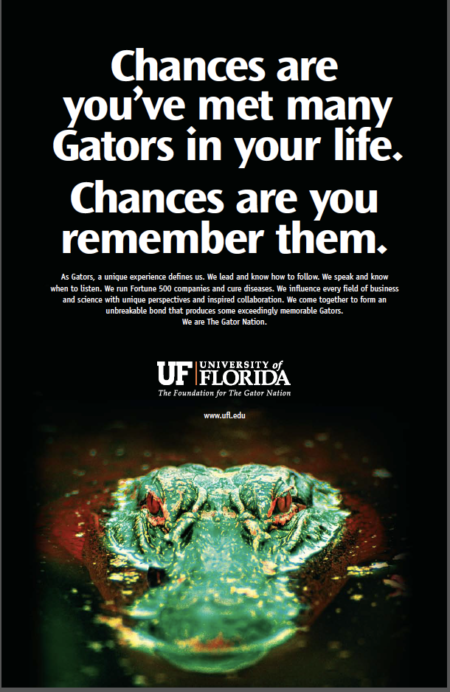
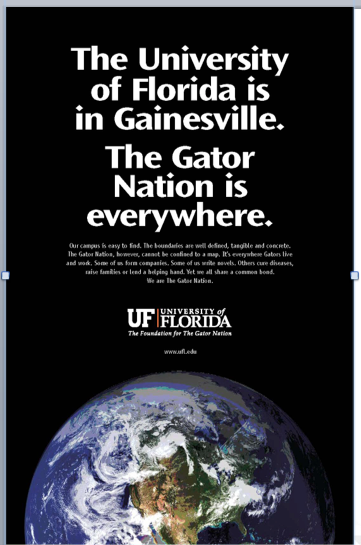
Aided by that campaign and the support of Gators around the world, UF has been named the Number 5 public university in the Nation. I couldn’t be prouder of my two-time alma mater and all the hard work that went into this accomplishment.
And just think, 16 years ago it was just a dream. Today there has never been a truer statement, The University of Florida is in Gainesville. The Gator Nation is everywhere!
Enjoy some of the early work that kicked off the campaign.
September 13, 2021 No Comments
The New Buzz word: BRAND ATTACHMENT
August 3, 2021 No Comments
Currall steps down from USF
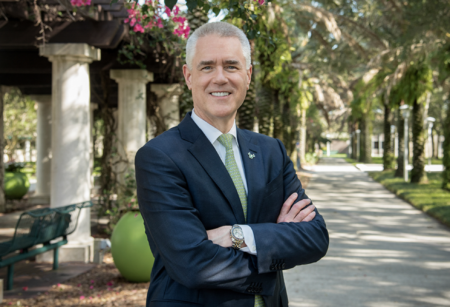
The past 24 months have been unprecedented in higher education and Steve Currall did a masterful job steering USF through the challenges of Covid-19, consolidation, budget cuts, systemic racism and more. He was always willing to listen and he wasn’t afraid to act decisively. He’s going to be missed at the helm of USF, but I’m glad to hear he will remain with the university in a teaching and research capacity. Here’s wishing Steve and Cheyenne Currall only the very best. Go Bulls!
https://www.usf.edu/news/2021/currall-announces-retirement-from-university-of-south-florida-presidency.aspx
July 19, 2021 No Comments